The Benshi Archive
note: Japanese names appear in the conventional Japanese order, with the family name first, followed by the given name. For example, “Tokugawa” in Tokugawa Musei is the historical benshi’s “family” name, though the entire name is a stage name. (He was born Fukuhara Toshio.) Contemporary benshi, Kataoka Ichiro uses his real name as his stage name. Kataoka is his family name, followed by his given name, Ichiro.
This archival photograph captures a moment in an historical recreation of benshi performance at a TV studio in the mid-1960s. It features Matsuda Shunsui (1925-87), who had become famous as a child benshi thirty years earlier during the silent film era. On its own, this photograph documents at least two instances of the desire to preserve and disseminate the transitory pleasures of benshi performance using state-of-the-art technology. In their palimpsestic layering of media, both the television program and the archival photograph testify to just how strong and pervasive that desire has been for nearly a century now.
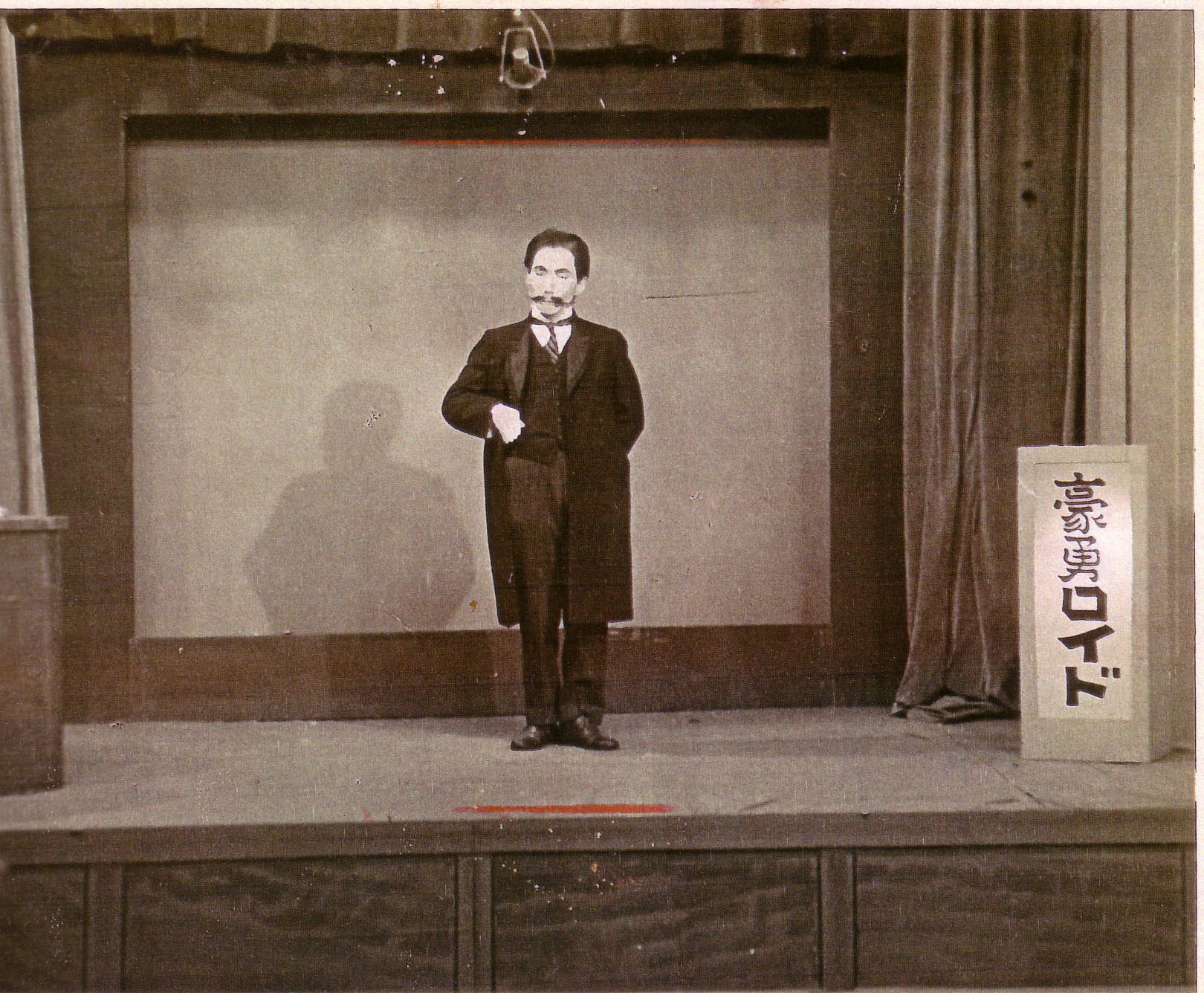
Matsuda Shunsui
Photograph courtesy of Matsuda Film Productions
In a similar fashion, this benshi digital archive seeks to bring the latest technological and scholarly resources to bear on the effort to preserve the history of benshi silent film narrators, to recreate their dynamic, multi-sensory theatrical performances, and to chart their broad cultural impact. To this end, and with support from the Library and IT Services at my home institution, Hamilton College, I have digitized a growing corpus of historical and contemporary materials relating to benshi performance and fan culture from their beginnings in the early decades of the twentieth century up to the present. At this point, materials in the archive include historical recordings of individual benshi performances, which have been synchronized with the relevant films. Also featured are virtual reconstructions of two historical theaters in Tokyo that are no longer standing, Shinjuku Musashino-kan and Akasaka Tameike Aoi-kan. In addition, there is a substantial, curated collection of ephemera relating to benshi performance, including benshi textbooks and scripts, popular magazines, newspaper articles, reviews, and announcements, as well as novelty items such as ranking charts and other items of historical benshi fan culture. Finally, the archive includes video and audio recordings of several contemporary benshi performances, along with their original scripts, including ones for the 1986 “silent” film by Hayashi Kaizo, Yume miru yo ni nemuritai (To Sleep So as to Dream).
These diverse materials span three separate periods: the silent film era of the 1900s through the 1930s; the retrospective and nostalgic era from the 1940s-1980s when pre-WWII benshi performed alongside old silent films; and the contemporary benshi era of the 1990s to the present. Today’s benshi develop their performing styles by combining painstaking historical research with their own aesthetic expression in order to make the silent film experience relevant and enjoyable to contemporary audiences. This Benshi Archive places a special emphasis on the second (the 1940s – 80s) and third (the 1990s – the present) of these periods.
